
In 1966 James Brown released the song “It’s a Man’s World” in which he sang “this is a man’s world but it would be nothing without a woman or a girl”.
Only 2 years before James Brown’s song hit the top of the charts, the Equal Pay Act made it illegal to pay a person less based on sex. But it would take decades and extra layers of protections on top of EPA to make the American workplace more inclusive of minority groups.
1960s
- 1964-1973 For the first nine years, the Equal Pay Act did not extend to the white collared, those in an executive, administrative or professional capacity, or as an outside salesperson.
- 1966 Contradictory laws and loopholes around EPA resulted in the founding of the National Organization for Women (NOW).
- 1967 Age restrictions on flight attendants was deemed illegal sex discrimination.
In the 1970s women fought for a spot in the workplace and control of their bodies. They gained a voice in the media, and sexual harassment and pregnancy discrimination was first defined.
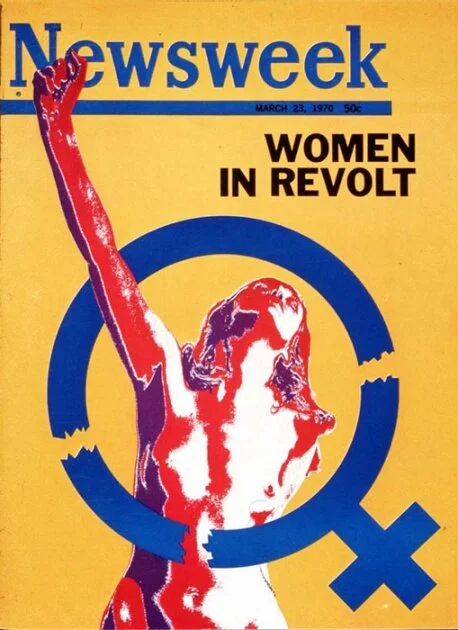
- 1970 Sixty female employees claimed that Newsweek only allowed men to be reporters. The day the claim was filed, Newsweek's released an issue titled "Women in Revolt", which had been written by a female on a freelance basis since there were no female reporters at the magazine. Ultimately Newsweek changed their policy.
- 1970 Schultz v. Wheaton Glass Co., a case brought to a circuit court of appeals, defined that hiring a woman to do the same job as a man but giving the job a new title in order to offer a lesser pay is a form of discrimination.
- 1976 Williams v. Saxbe defined sexual harassment / advances as a form of sex discrimination in hiring.
- 1978 The Pregnancy Discrimination Act amended Title VII of the Civil Rights Act of 1964 to "prohibit sex discrimination on the basis of pregnancy, childbirth, or related medical conditions." Today it still only applies to employers with 15 or more employees.
- 1978 Bathroom segregation and availability remains an issue in countries like India, where women are advised to limit their intake of food and beverages while out because it can be difficult to find female restrooms. A lack of female restrooms is one way some societies encourage women to stay home. The issue was largely overcome in the US between 1887 and 1920. But it lingered, as exhibited in the federal lawsuit, Melissa Ludtke and Time, Inc., Plaintiffs, v. Bowie Kuhn, Commissioner of Baseball et al. (1978). Melissa, a sports reporter, sued because she was denied access to the restrooms in the clubhouse locker room, which impeded her ability to do her job.
1980s
- 1989 Price Waterhouse failed to prove that the decision to postpone a female employee’s promotion to Partner was not based on gender discrimination. This case (Price Waterhouse v. Hopkins) established that gender stereotyping is sex discrimination. It also established that a mixed-motive framework can be used to prove discrimination under a disparate treatment theory even when lawful adverse actions are also present.
1990s
During the 1970s and 1980s, all that could be awarded when suing for discrimination was backpay, reinstatement, and attorney’s fees. That changed with the Civil Rights Act of 1991, which expanded rights to collect compensatory and punitive damages.
Lawsuits in the 90s pushed big changes in workplace environments and checked the powers of workplace supervisors.
- 1991 Robinson v. Jacksonville Shipyards, Inc., a Florida district court judge ruled that "pictures of nude and partially nude women" placed throughout the workplace do constitute sexual harassment.
- 1991 United Automobile Workers v. Johnson Controls, Inc. decided that private sector policies which allow men but not women to knowingly work in potentially hazardous occupations is gender discrimination.
- 1997 Gloria Allred represented Melrose Place actress Hunter Tylo when producer Aaron Spelling fired her for being pregnant. A jury awarded Tylo $4.8 million. The case backed actors’ right to continue work if they become pregnant.
- 1998 Faragher v. City of Boca Raton, and Burlington Industries, Inc. v. Ellerth, are often considered alongside each other. They both went to the Supreme Court and identified the circumstances under which an employer may be held liable under Title VII for the acts of a supervisor whose sexual harassment has created a hostile work environment amounting to employment discrimination. Burlington vs. Ellerth also introduced a two-part affirmative defense allowing employers to avoid liability if they follow workplace best practices.
- 1998 Oncale v. Sundowner Offshore Services, arose out of a suit for sex discrimination by a male oil-rig worker, who claimed that he was repeatedly subjected to sexual harassment by his male co-workers with the acquiescence of his employer. The Court held that Title VII's protection against workplace discrimination "because of... sex" applied to harassment between members of the same sex.
- 1999 United States House of Representatives appropriations bill passed that contained an amendment specifically permitting breastfeeding. It stipulated that no government funds may be used to enforce any prohibition on women breastfeeding their children in federal buildings or on federal property. This laid the groundwork for a workplace related law on breastfeeding that would later be passed in 2014.
The 2000s challenged healthcare offerings, beauty stereotypes, and lengthened the pay discrimination statute of limitations.
- 2000 The Equal Employment Opportunity Commission ruled that companies that provided health insurance for prescription drugs but excluded birth control were in violation of the Civil Rights Act of 1964.
- 2003 In Eduardo Gonzalez, et al. v. Abercrombie & Fitch Stores, Inc., Abercrombie & Fitch was guilty of "violating Title VII of the Civil Rights Act in recruiting and hiring practices that excluded minorities and women and adopted a restrictive marketing image”. Although Abercrombie never admitted fault, it collectively paid $50 million in settlements to employees who filed. Abercrombie agreed to take actions to promote diversity among its workforce and prevent discrimination based on race, and those actions were monitored until 2011.
- 2006 Jespersen v. Harrah's Operating Co., originally filed in 2001, went to the 9th circuit court of appeals in 2006. Darlene Jespersen, a 20-year employee, was challenging Harrah's Casino in Reno, Nevada. The casino implemented a "Personal Best" policy in 2000, which created standards for employee grooming, including that women wear substantial amounts of makeup. Jespersen was fired for non-compliance and later argued the requirement violated Title VII. The Circuit panel concluded, in contrast to the previous rulings, that such grooming requirements could be challenged as sex stereotyping. However, they found that Jespersen had not provided evidence that the policy had been motivated by stereotyping.
- 2007-2009 Ledbetter v. Goodyear Tire & Rubber Co., is a Supreme Court case that determined employers cannot be sued under Title VII over race or gender pay discrimination if claims are based on decisions made by the employer 180 days ago or more. Ledbetter's claim of the "paycheck accrual rule" was rejected.
Two years later the Lilly Ledbetter Fair Pay Act of 2009 was the first bill signed into law by President Barack Obama, overwriting the Supreme Court’s statute. The act states that the 180-day statute of limitations for filing an equal-pay lawsuit regarding pay discrimination resets with each new paycheck affected by that discriminatory action.
- 2009 Crawford v. Metropolitan Government of Nashville, is a Supreme Court case that unanimously ruled Title VII protects any employee who opposes sexual harassment, but does not report the harassment themselves.
2010s
- 2010 Reeves v. C.H. Robinson Worldwide, Inc. ruled that a hostile work environment can be created in a workplace where sexually explicit language and pornography are present, even if it is not targeted at any particular employee.
- 2010 Section 4207 of the Patient Protection and Affordable Care Act amended the Fair Labor Standards Act by requiring employers to provide a reasonable break time for breastfeeding, if the child is younger than one year old. The employee must be allowed to breastfeed in a private place, other than a bathroom. The employer is not required to pay the employee during the break time. Employers with fewer than 50 employees are not required to comply with the law if doing so would impose hardship to the employer based on its size, finances, nature, or structure of its business.
- 2013 Vance v. Ball State University is a U.S. Supreme Court case that clearly defined "supervisor" within harassment lawsuits. The case was important because it resolved the dispute between several different circuits. The Supreme Court determined that an employee is a "supervisor" only if they are in a position permitted by the employer to take tangible employment actions against the victim.
- 2014 Young v. United Parcel Service, is a United States Supreme Court case that evaluated and determined that to bring a disparate treatment claim under the Pregnancy Discrimination Act, a pregnant employee must show that their employer refused to provide accommodations and also later provided accommodations to other employees with similar restrictions.
- 2015 Ellen Pao v. Kleiner Perkins Caufield & Byers LLC and DOES 1–20 was a lawsuit filed in 2012 in San Francisco County Superior Court by executive Ellen Pao for gender discrimination. The case was closely covered by reporters, Silicon Valley, and advocacy groups for two reasons. First, it was happening while several studies on the lack of female representation in venture capital were published. Second, it was uniquely high profile, as many similar cases tended to reach settlements out of court. The jury found in favor of Kleiner Perkins on all counts, though it was one of many events that promoted change in California state laws requiring representation of women in high levels of corporate structures.
- 2017 The 9th U.S. Circuit Court of Appeals ruled that employers could pay women less than men for the same work if based on differences in the workers' previous salaries.
- 2019 California became the first state in America to require women to be included on companies’ boards of directors. The law required all publicly traded companies have one woman on their boards by the end of 2019. In 2021 it required that on boards of 6 or more, at least 3 members be women.
2020s
- June 15th, 2020. Bostock v. Clayton County. This landmark United States Supreme Court civil rights case held that Title VII protects employees against discrimination because of their sexual orientation or gender identity. Until this decision, it was legal in more than half of US states to fire workers for being gay, bisexual or transgender.
US Military
The US government is the largest employer in the country.
In 1967 Lyndon B. Johnson signed Executive Order 11375, that banned sex discrimination in hiring in the federal workforce including government contractors. And he eliminated the 2% ceiling on enlisted women and allowed females to be promoted above Officer. Unfortunately, some military academies like the Virginia Military Institute, maintained a male-only admission policy. It wasn’t until 1996 in United States v. Virginia, that the admission policy was changed.
In National Coalition for Men v. Selective Service System in 2019, courts ruled that the exclusion of female conscription from the male-only draft in the United States was unconstitutional. The case did not specify any action that the government must take. However this likely means that if there is ever another draft, able women will be required to go to war for the first time in US history.